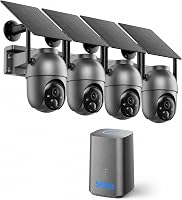
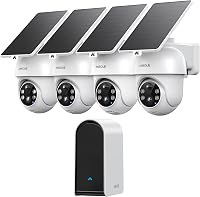
9 Best Wireless Security Cameras with Local Storage (November 2026)
The best wireless security cameras with local storage include the SEHMUA Security Cameras Wireless Outdoor Kit for complete solar coverage, the realhide 2026 Enhanced 2K UHD Security Cameras for flexible SD and cloud storage, and the HITELLARCAM 2026 Upgraded 2K Security Cameras Wireless for battery flexibility.
On this page (7 sections)
- Which wireless security cameras with local storage stand out?
- Best wireless security cameras with local storage
- How should you choose local storage for a wireless camera?
- Are solar cameras better than battery cameras?
- How do wireless cameras save footage locally?
- What should you check before installing a wireless camera?
- Which wireless security camera with local storage should you buy?
The best wireless security camera with local storage for most homes is the SEHMUA Security Cameras Wireless Outdoor Kit. It combines 4 outdoor cameras, a Sehmuabase with built-in 64GB encrypted storage, solar power and no monthly cloud fee.
That mix suits households where one camera cannot cover a driveway, a porch and a side yard at the same time. Four views can be checked together, and the hub keeps recordings in one indoor place rather than in separate cameras.
Choose BOTSLAB if 4K detail and large base-station expansion matter most. Its 32GB base station can grow to 16TB with a separate hard drive, which changes how long footage can be kept.
Choose Tapo if you need one camera and want to add a microSD card without installing a multi-camera hub. That simpler setup can fit a single entry point, a garage or an indoor room.
Local storage can mean an SD card inside the camera or memory inside a connected base station. Our guide to the best security cameras with local storage explains how those designs differ.
The right design depends on where you want footage kept and how many areas you need to watch. A card in the camera is compact, while a hub can make four-camera playback easier to manage.
SEHMUA uses motion-triggered recording, so it does not save continuous video all day. That trade-off helps solar power and storage last longer, but you should check the recording mode before you rely on it for a specific area.
For a home with several outdoor spots and no desire for a cloud subscription, the SEHMUA kit gives a clear starting point. Its built-in storage, solar panels and four-camera scope make the setup easier to plan than buying separate cameras one by one.
Our picks at a glance
-
1
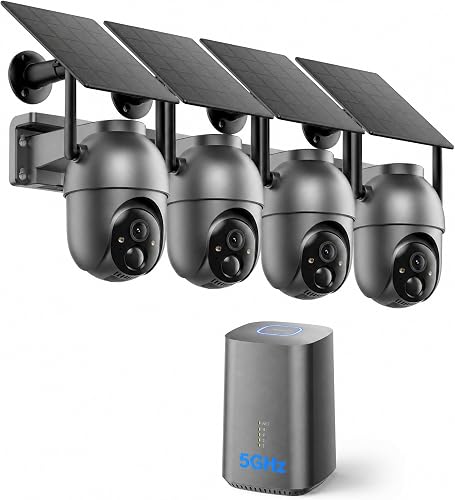 Best for complete solar coverage
SEHMUA Security Cameras Wireless Outdoor Kit
9.7/10 our score
See it on Amazon -
2
 Best for flexible SD and cloud storage
realhide 2026 Enhanced 2K UHD Security Cameras
9.4/10 our score
See it on Amazon -
3
 Best for battery flexibility
HITELLARCAM 2026 Upgraded 2K Security Cameras Wireless
9.3/10 our score
See it on Amazon
- 4
 Check it
BOTSLAB 4K Security Camera Wireless Outdoor
Best for 4K multi-camera detail - 5
 Check it
Tapo 1080p Outdoor Wireless Security Camera
Best for one-camera simplicity - 6
 Best for 2.4GHz multi-camera coverageCheck it
- 7
 Check it
Tapo 1080p Outdoor Wireless Security Camera
Best for 3-camera Tapo coverage - 8
 Check it
Vivideye 4MP Security Cameras Wireless Outdoor
Best for large built-in storage - 9
 Check it
aosu 2K Solar Security Cameras Wireless Outdoor
Best for expandable base storage
Which wireless security cameras with local storage stand out?
The strongest picks combine a clear storage path with a practical power setup and enough coverage for the area you need to watch. Solar kits work well for outdoor locations without nearby outlets, while battery cameras are easier to place but need periodic charging.
We compared storage capacity, camera count, resolution, power source, network bands and recording limits. Our score weighs specs, features and buyer feedback against what you're shopping for.
A camera with strong video still needs a storage plan that matches daily use. If it records often, a small card or base station can fill faster than expected.
Power also changes how a camera fits your home. Solar power reduces charging visits, while a rechargeable battery gives more freedom to place a camera in shade.
Network support matters during setup and viewing. A 2.4GHz-only model may reach farther through walls, while a dual-band model can use the faster band when the camera is closer to the router.
Recording mode is another practical limit. Event-based recording saves energy and space, while continuous recording needs a different power and storage plan.
| Product | Best for | Storage | Camera count | Power | Our score |
|---|---|---|---|---|---|
| SEHMUA Security Cameras Wireless Outdoor Kit | complete solar coverage | Built-in 64GB, expandable up to 256GB | 4 | Solar powered | 9.7 |
| realhide 2026 Enhanced 2K UHD Security Cameras | flexible SD and cloud storage | SD card up to 256GB or free rolling cloud | Battery, up to 6 months | 9.4 | |
| HITELLARCAM 2026 Upgraded 2K Security Cameras Wireless | battery flexibility | Local SD card up to 256GB or free cloud | 9.3 | ||
| BOTSLAB 4K Security Camera Wireless Outdoor | 4K multi-camera detail | 32GB local storage, expandable up to 16TB | 4 | 9.2 | |
| Tapo 1080p Outdoor Wireless Security Camera | one-camera simplicity | MicroSD up to 512GB, sold separately | 9.0 | ||
| GMK 4 Pack Cameras System | 2.4GHz multi-camera coverage | MicroSD up to 128GB or cloud storage | 4 | 8.4 | |
| Tapo 1080p Outdoor Wireless Security Camera | 3-camera Tapo coverage | MicroSD up to 512GB, sold separately | 3 | Battery powered | 8.3 |
| Vivideye 4MP Security Cameras Wireless Outdoor | large built-in storage | Built-in 128GB MicroSD card in base unit | 4 | Solar powered | 8.0 |
| aosu 2K Solar Security Cameras Wireless Outdoor | expandable base storage | 32GB local storage, expandable up to 1TB | 4 channels | 7.9 |
Best wireless security cameras with local storage
SEHMUA leads this roundup because it brings together four cameras, built-in storage and solar power. The remaining choices fit different needs, including 4K detail, SD card flexibility, single-camera setup and expandable storage.
SEHMUA Security Cameras Wireless Outdoor Kit: Best for complete solar coverage
- 4 cameras
- Built-in 64GB local storage
- Expandable up to 256GB
- Solar powered
- 350° pan and 90° tilt
Four solar cameras and a base station make this a strong fit for homes that need several outdoor views without monthly cloud fees.
Pros
- Built-in local storage
- Solar power
- 4MP color night vision
- 4-camera monitoring
Cons
- Motion-triggered recording only
- Base station uses a 3-meter Ethernet cable
SEHMUA is the best fit when you want one local system watching several outdoor areas. The kit includes 4 wireless outdoor cameras, 4 solar panels and a Sehmuabase with built-in 64GB storage.
The local storage can expand up to 256GB, and the system supports up to 120 days of recording history. Recording is motion-triggered rather than 24/7 continuous, which helps conserve storage and solar power.
Each camera supports 4MP video, 350° pan, 90° tilt and 4x digital zoom. The integrated spotlight provides full-color night vision up to 65 ft, while human detection can reduce alerts from movement such as swaying leaves.
The base connects to your router with the included 3-meter Ethernet cable. The cameras can also support 2.4GHz and 5GHz WiFi when used separately after a factory reset.
Choose SEHMUA for driveways, porches, yards or several outdoor zones. Its main trade-off is that the system needs sunlight for solar charging and records when motion is detected rather than continuously.
realhide 2026 Enhanced 2K UHD Security Cameras: Best for flexible SD and cloud storage
- 2K video
- SD card support up to 256GB
- Free rolling cloud storage
- Dual-band WiFi
- Up to 6-month battery
The realhide gives you a local SD card option while keeping free rolling cloud storage available as a backup choice.
Pros
- Local SD card support
- 2K full-color night vision
- 2.4GHz and 5GHz WiFi
- IP66 weather protection
Cons
- SD card is not included
- Battery life varies with detection
realhide suits buyers who want local SD storage without giving up a free rolling cloud option. Its 2K camera supports an SD card up to 256GB, while the battery can last up to 6 months depending on detection activity.
The camera supports both 2.4GHz and 5GHz WiFi, which gives you more network flexibility than the 2.4GHz-only models in this group. Its 2K video and full-color night vision help preserve detail after dark.
IP66 weather protection suits outdoor mounting near a fence, garage, front door or backyard. Motion alerts arrive through the app, and two-way audio lets you speak with visitors or delivery drivers.
The SD card is not included, so plan for that separate storage step. Local recording keeps footage in the camera, while the free rolling cloud option can act as a backup path.
Choose realhide when you want one wireless camera that can use local storage or free cloud storage, with a battery instead of a solar panel. It fits a single location where placement, weather protection and storage choice matter more than multi-camera hub playback.
HITELLARCAM 2026 Upgraded 2K Security Cameras Wireless: Best for battery flexibility
- 2K video
- Local SD card support up to 256GB
- Free cloud storage
- 5200mAh battery
- 2.4GHz and 5GHz WiFi
This camera suits buyers who want local SD recording, free cloud storage and a rechargeable battery in one wireless unit.
Pros
- Local SD card support
- AI motion detection
- Full-color night vision
- Two-way audio
Cons
- SD card is not included
- Battery estimates vary by motion activity
HITELLARCAM is a strong option for buyers who want a rechargeable wireless camera with both local and cloud storage paths. It supports a local SD card up to 256GB, while its free cloud plan offers an additional access option.
The camera records in 2K resolution and adds full-color night vision with a built-in spotlight. AI motion detection sends phone alerts, and two-way audio supports conversations with visitors or delivery personnel.
Its 5200mAh rechargeable battery can last from 1 to 6 months depending on use. The brand's stated test conditions include 60 days at 100 motion triggers per day, so high activity can shorten the time between charges.
The camera supports 2.4GHz and 5GHz WiFi and has IP66 waterproof and dustproof protection. That combination suits an outdoor wall or eave where weather and network range both need attention.
The SD card is not included, so local storage requires a separate card. Choose it for a single outdoor location where you want app alerts, local SD recording and flexible battery expectations.
BOTSLAB 4K Security Camera Wireless Outdoor: Best for 4K multi-camera detail
- 4 cameras
- 4K video
- 32GB base-station storage
- Expandable up to 16TB with a hard drive
- Solar powered
BOTSLAB is the high-detail choice for a four-camera outdoor setup, with local base-station storage and optional hard-drive expansion.
Pros
- 4K video
- 4-camera kit
- Base-station storage
- Solar panels
Cons
- External hard drive is sold separately
- Base station is required for local storage
BOTSLAB is the best wireless camera system here for buyers who want 4K detail across four outdoor views. The kit includes four cameras, a base station, four mounting brackets and four solar panels.
The H200 base station includes 32GB of local storage and can expand up to 16TB with a separate 2.5-inch hard drive. This gives you a much larger storage path than systems limited to a memory card.
The cameras use 8MP 4K video, 360° horizontal rotation and 136° vertical rotation. The system also supports color night vision, AI recognition for people and vehicles, and synchronized playback across cameras.
Solar panels and built-in 10000mAh batteries reduce the need for routine charging. Local storage depends on the base station, so place it where the included network connection and indoor equipment can remain protected.
Choose BOTSLAB when identifying distant details matters more than keeping the setup small. The main added cost to plan for is a separate hard drive if 32GB is not enough.
Tapo 1080p Outdoor Wireless Security Camera: Best for one-camera simplicity
- 1080p video
- MicroSD support up to 512GB
- Up to 180-day battery
- Person detection
- Alexa and Google Assistant support
The Tapo C400 keeps local storage simple for one indoor or outdoor camera, with a high-capacity microSD option and a rechargeable battery.
Pros
- Up to 512GB microSD support
- Person detection
- Color night vision
- Smart home support
Cons
- MicroSD card is sold separately
- 1080p resolution is lower than the 2K and 4K picks
The Tapo C400 fits a buyer who needs one wireless camera with a straightforward local storage option. It records to a microSD card up to 512GB, sold separately, and can also use Tapo Care cloud storage.
The camera provides 1080p video, person detection and full-color night vision. Its 5200mAh rechargeable battery is rated for up to 180 days under the brand's stated test conditions, which include 250 seconds of use per day.
It works indoors or outdoors and supports Alexa and Google Assistant on supported displays. Two-way audio and adjustable light alarms add ways to respond when someone enters a monitored area.
At 15 frames per second, its video specification is lower than the 2K and 4K picks. That can matter when you need fine detail from a distance, especially at night.
The microSD card is sold separately, so check the total setup before installation. Choose it when one camera, large microSD support and a familiar smart-home connection matter more than maximum detail.
GMK 4 Pack Cameras System: Best for 2.4GHz multi-camera coverage
- 4 cameras
- 2K video
- MicroSD support up to 128GB
- Battery powered
- 2.4GHz WiFi
GMK covers four areas with 2K cameras and local microSD storage, making it useful when your network already relies on 2.4GHz WiFi.
Pros
- 4-camera kit
- 2K video
- Local microSD option
- Sleep schedules
Cons
- Does not support 5GHz WiFi
- 24/7 continuous recording is not supported
GMK is useful when you need four cameras and your network uses 2.4GHz WiFi. The system records to a microSD card up to 128GB or an encrypted cloud service, and it does not support 5GHz WiFi.
Each camera records 2K 3MP video and includes color night vision, two-way talk and a siren with flashing white lights. The VicoHome app manages all four cameras and supports shared viewing for invited users.
The cameras are battery powered and can also use constant plug-in power. That hybrid option can help in a busy entryway where motion triggers would drain a battery faster.
A sleep mode and custom schedules help reduce recording during times when you do not need monitoring. They can also help protect privacy when people are home during the day.
This system does not support 24/7 continuous recording. Choose GMK for motion-based coverage of a porch, garage, yard or indoor room when 2.4GHz range is more important than high-capacity storage.
Tapo 1080p Outdoor Wireless Security Camera: Best for 3-camera Tapo coverage
- 3 cameras
- 1080p video
- MicroSD support up to 512GB
- Battery powered
- Color night vision
This C401 3-pack makes sense when you want several Tapo cameras with local microSD recording rather than a single-camera setup.
Pros
- 3-camera kit
- Up to 512GB microSD support
- Person detection
- Two-way audio
Cons
- MicroSD cards are sold separately
- 1080p video has less detail than 2K and 4K options
The Tapo C401 3-pack suits homes that need three Tapo cameras instead of one. Each camera uses battery power, supports local microSD recording up to 512GB and includes color night vision and person detection.
The cameras record in 1080p and work indoors or outdoors. The 5200mAh battery is rated for up to 180 days under typical use, but motion frequency, settings and viewing time affect how often charging is needed.
The three-camera package includes mounting hardware, USB charging cables, brackets and quick-start materials. Having the same app and storage approach across three locations can simplify daily checks.
It also supports Alexa and Google Assistant on compatible displays. That can help when a camera is placed in a room or entryway where voice viewing is more convenient than opening the app on a phone.
MicroSD cards are sold separately, so storage is not ready until you add cards for the cameras. Choose this kit when you want three locations covered with local storage, while accepting less detail than 2K and 4K systems.
Vivideye 4MP Security Cameras Wireless Outdoor: Best for large built-in storage
- 4 cameras
- Built-in 128GB home-unit storage
- Solar powered
- 4MP video
- 2.4GHz and 5GHz WiFi
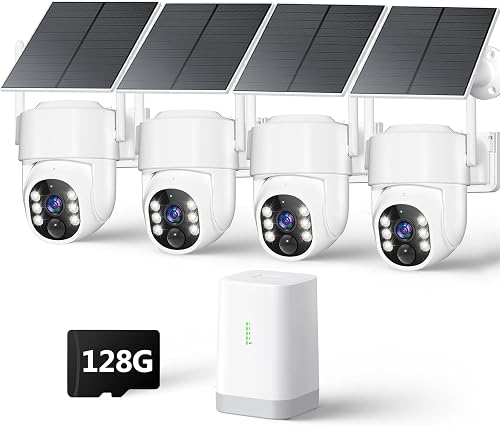
Vivideye pairs four solar cameras with a 128GB home unit, so you can begin with local storage already installed.
Pros
- 128GB local storage
- 4-camera kit
- Solar panels
- Dual-band WiFi
Cons
- Auto tracking is off by default
- Event recording settings need attention
Vivideye is a good match when you want four solar cameras with 128GB local storage already installed in the home unit. The kit includes four cameras, four 5W solar panels and a base unit with a built-in 128GB MicroSD card.
The cameras use 4MP video, full-color night vision and 360° coverage. Dual-band WiFi supports 2.4GHz and 5GHz, while the base unit can connect through Ethernet or WiFi.
Human detection and two-way audio focus the system on people and remote communication. Auto tracking is turned off by default, so you need to enable it in the app if you want that behavior.
The system records event footage and automatically overwrites older recordings when storage fills. That loop keeps storage managed, but older clips are removed as new ones take their place.
Solar power reduces manual charging when panels get enough sunlight. Choose Vivideye for a ready-to-use four-camera local system, but review its detection settings during setup so the recording behavior matches your property.
aosu 2K Solar Security Cameras Wireless Outdoor: Best for expandable base storage
- 4-camera kit
- 2K video
- 32GB aosuBase storage
- Expandable up to 1TB
- Solar powered
The aosu system suits buyers who want four solar cameras, event-based recording and a base station that can grow to 1TB.
Pros
- Expandable local storage
- 4-view live monitoring
- Solar power
- Camera-to-camera tracking
Cons
- MicroSD expansion card is sold separately
- Event-based recording is not continuous
aosu gives you four solar cameras with 2K video and a 32GB aosuBase. The base can expand local storage up to 1TB with a separate microSD card, which gives you room to grow without changing the cameras.
The system supports four-view live monitoring and camera-to-camera tracking. PIR and AI human detection focus alerts on people, while full-color night vision, a spotlight and a siren support outdoor monitoring after dark.
The split solar panel design lets you place the camera where you need coverage and position the panel where it receives better sunlight. Solar performance still depends on season, placement, weather and camera settings.
The cameras use event-based recording rather than saving inactive hours. That approach can keep storage focused on activity, but it is not the same as continuous recording.
The expansion card is sold separately, and detection performance can vary by placement and lighting. Choose aosu when you want expandable base storage and coordinated four-camera review, especially where battery charging would be inconvenient.
How should you choose local storage for a wireless camera?
Choose a base-station system when you need several cameras, shared playback or more storage expansion. Choose an SD-card camera when you want a smaller setup with one camera and a simpler installation.
A base station keeps recordings in one indoor location. SEHMUA, BOTSLAB, Vivideye and aosu all use a hub or base unit for local video, while realhide, HITELLARCAM and Tapo use an SD card inside the camera.
Storage capacity affects how long footage stays available before older clips are overwritten. Event-based recording usually uses less space than continuous recording, but detection settings can change how many clips are saved.
If you want to avoid cloud storage entirely, compare the system's local features before buying. Our guide to the best security camera system no subscription covers storage, alerts and setup trade-offs.
Are solar cameras better than battery cameras?
Solar cameras can reduce charging work when the panel receives enough direct sunlight. Battery cameras are easier to place in shaded locations, but you need to plan for recharging based on motion activity and viewing habits.
SEHMUA, BOTSLAB, Vivideye and aosu use solar power. realhide, HITELLARCAM and Tapo use rechargeable batteries, while GMK supports battery operation and constant plug-in power.
A solar camera still needs a clear panel position and an appropriate recording mode. Event-based recording can help reduce energy use, while frequent alerts, live views and night lights can increase demand.
Battery life claims also depend on how often the camera wakes up. A busy driveway can use more power than a quiet side yard, even with the same camera model.
Placement should start with the view you need, then the power source. Put the camera where it can see the entry point or yard, and put the solar panel where it can collect sunlight without being blocked by a roof or tree.
For battery models, choose a spot you can reach safely for charging. A camera that is hard to reach may stay in use longer if it needs less frequent charging, but access still matters over time.
Seasonal light can change solar performance throughout the year. A panel that works well in summer may need a better position or a lower-energy recording setting in darker months.
For more placement advice, compare our guide to the best outdoor security camera with local storage. It focuses on weather exposure, solar placement and outdoor recording needs.
GMK adds another option with constant plug-in power for high-traffic spots. That can reduce battery worry where an outlet is available, while solar and battery models fit places without wiring.
How do wireless cameras save footage locally?
Wireless cameras save footage either to a memory card in the camera or to storage inside a connected base station. The camera still uses wireless communication for app access or camera-to-hub connections, but the recordings do not have to be stored in the cloud.
SD-card systems are compact, but the card remains at the camera location. Base-station systems keep footage together indoors, which can make multi-camera review easier and can protect recordings if an outdoor camera is damaged or removed.
Some products use both local and cloud storage. realhide, HITELLARCAM, Tapo and GMK offer local recording alongside an optional or free cloud path, while SEHMUA, BOTSLAB, Vivideye and aosu focus on local base or hub storage.
Our explanation of what a local only security camera system is can help if you want recordings kept within your own equipment.
What should you check before installing a wireless camera?
Check the camera's power source, WiFi band, storage location, detection area and mounting position before you install it. These details affect daily use more than resolution alone.
Measure the distance to your router or base station. A 2.4GHz-only camera such as GMK may offer wider coverage through obstacles, while dual-band models such as realhide, HITELLARCAM, Vivideye and SEHMUA give you more network choices.
For solar models, place the panel where it can receive direct sunlight and keep the camera aimed at the area that matters most. For battery models, install them where you can safely recharge them without moving a ladder through a busy area.
Keep the storage device protected, set a strong account password and review alert zones after installation. If you are deciding between a battery camera and a wired option, read what a plug-in security camera does.
Which wireless security camera with local storage should you buy?
Pick SEHMUA if you want the best balance of four-camera coverage, solar power and built-in local storage. Its 64GB base storage can expand to 256GB, and the kit is built for several outdoor views without a monthly cloud fee.
Pick BOTSLAB if 4K detail and hard-drive expansion matter more than a smaller setup. The 32GB base station can grow to 16TB with a separate hard drive, which suits longer retention plans.
Choose Tapo C400 for one camera with microSD support up to 512GB. Choose realhide or HITELLARCAM when you want a battery camera with both local SD recording and a cloud option.
For a ready-installed 128GB hub, choose Vivideye. For expandable 1TB base storage, choose aosu.
For a four-camera 2.4GHz system, GMK remains a practical fit if continuous recording and 5GHz WiFi are not requirements. Its sleep schedules and plug-in power option can help in busy or private areas.
The best wireless security camera with local storage is the one whose power, recording mode and storage location match your property. Start with coverage needs, then choose the local storage capacity you can manage.
Our top 3 picks at a glance
-
1
Best for complete solar coverage
SEHMUA Security Cameras Wireless Outdoor Kit
9.7/10 our score
See it on Amazon -
2
Best for flexible SD and cloud storage
realhide 2026 Enhanced 2K UHD Security Cameras
9.4/10 our score
See it on Amazon -
3
Best for battery flexibility
HITELLARCAM 2026 Upgraded 2K Security Cameras Wireless
9.3/10 our score
See it on Amazon
Frequently asked questions
What is the best wireless security camera with local storage?
The SEHMUA Security Cameras Wireless Outdoor Kit is the strongest overall choice here because it combines 4 cameras, built-in 64GB encrypted local storage, solar power and no monthly fee. BOTSLAB is better for 4K detail, while Tapo suits a simpler single-camera installation with a microSD card.
Do wireless security cameras record without WiFi?
Some wireless security cameras can keep recording locally when the internet is unavailable, but the exact behavior depends on the design. Base-station systems store footage at the hub, while SD-card cameras save it in the camera.
Remote viewing may still need a network connection.
How much local storage do security cameras need?
A 32GB card or base station can suit event-based recording, while 128GB to 256GB gives more room for several cameras or frequent motion. A 512GB card or hard-drive expansion makes sense when you want longer retention.
Storage needs also depend on resolution and recording mode.
Are wireless security cameras with local storage secure?
Local storage keeps recordings on an SD card or base station instead of requiring cloud storage, which can reduce dependence on a subscription service. Use a strong account password, update the camera app and protect the base station or card from physical access.
Do solar security cameras record all the time?
Not always. Several solar cameras here use event-based or motion-triggered recording to save battery and storage.
Check the recording mode before buying, because solar power does not automatically mean a camera supports 24/7 continuous recording.