7 Best Battery Backups for Security Cameras (November 2026)
The best battery backups for security cameras include the CyberPower CP1500PFCLCD PFC Sinewave UPS Battery Backup for larger camera networks, the APC BE425M UPS Battery Backup and Surge for a compact router-camera setup, and the APC BX1500M UPS Battery Backup & Surge for cameras plus a recorder.
On this page (6 sections)
- The best battery backups for security cameras
- How do you choose a battery backup for security cameras?
- How much battery backup do security cameras need?
- Should you use a battery-powered security camera instead?
- How should you set up and care for a security camera UPS?
- What is the best battery backup security camera setup?
The best battery backup for security cameras is the CyberPower CP1500PFCLCD for larger camera and network setups. Its 1500VA/1000W capacity, sinewave output and 6 battery-backed outlets leave room for a recorder, router and other essential equipment.
That extra capacity matters when the backup must do more than keep a single camera alive. A recorder, network switch or desktop monitor can add a steady load, and headroom can help the UPS handle short outages more calmly.
A smaller system may need less. The Shanqiu mini UPS fits one compatible DC-powered camera, while the APC BE425M works well for a low-power router, modem and camera arrangement.
Think about what has to stay on for recording and remote viewing to keep working. The camera matters, but so does the router or modem that carries the feed to your phone or cloud service.
For one or two cameras, a compact unit can keep the setup tidy and close to the wall. For a system with an NVR, several network devices or a monitor, a tower UPS may be easier to plan.
The right choice depends on the camera's power input, the equipment connected with it and the outage runtime you need. Match the output type first, then check wattage and the number of battery-backed outlets.
Runtime is not a fixed promise for every home. It changes with the load, so a lightly loaded UPS may run longer than the same unit feeding a recorder, router and monitor together.
Connecting only essential devices to battery-backed outlets helps preserve runtime. Less critical equipment can use surge-only outlets for protection without using battery power.
For a Swann camera, also check compatible Swann power adapters. That check can prevent a mismatch between the camera adapter and the backup you plan to use.
If you are comparing a complete system rather than individual devices, see our guide to the best battery backup for a security camera system. It helps to view the camera, recorder and network gear as one power plan.
For the power source itself, our guide to the best security camera power supply covers adapter matching and placement. Good placement can also make cable routing and future maintenance simpler.
The best backup is the one that matches your camera, powers the network gear it needs and leaves enough capacity for the outage length you expect.
Our picks at a glance
-
1
 Best for larger camera networks
CyberPower CP1500PFCLCD PFC Sinewave UPS Battery Backup
9.7/10 our score
See it on Amazon -
2
 Best for a compact router-camera setup
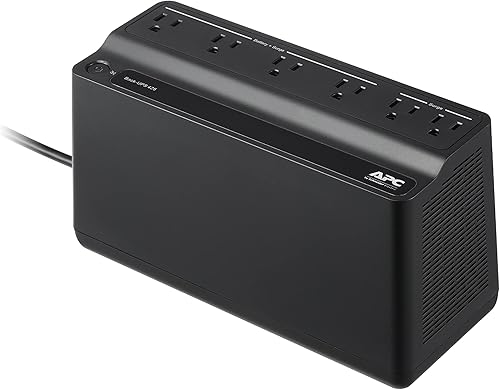
APC BE425M UPS Battery Backup and Surge
9.6/10 our score
See it on Amazon -
3
 Best for cameras plus a recorder
APC BX1500M UPS Battery Backup & Surge
9.5/10 our score
See it on Amazon
- 4
 Check it
CyberPower EC850LCD Ecologic UPS Battery Backup
Best for efficient home camera setups - 5
 Check it
GOLDENMATE 1000VA/800W Lithium UPS Battery Backup
Best for long battery service life - 6
 Check it
Shanqiu Mini UPS Battery Backup for Router
Best for one low-power camera - 7
 Check it
Vertiv Liebert PowerUPS 100 PST6-1100LVMT Battery Backup
Best for replaceable-battery maintenance
The best battery backups for security cameras
The best security camera battery backup depends on whether you need DC output for one camera or AC battery backup for cameras, routers and recording equipment. We compared capacity, outlet layout, output type, battery design and maintenance features.
| Product | Best for | Capacity | Outlets | Size | Our score |
|---|---|---|---|---|---|
| CyberPower CP1500PFCLCD PFC Sinewave UPS Battery Backup | larger camera networks | 1500VA/1000W | 6 battery backup and surge, 6 surge-only | 14 x 3.9 x 11 in | 9.7 |
| APC BE425M UPS Battery Backup and Surge | a compact router-camera setup | 425VA/255W | 4 battery backup and surge, 2 surge-only | 10 x 5.5 x 4.1 in | 9.6 |
| APC BX1500M UPS Battery Backup & Surge | cameras plus a recorder | 1500VA/900W | 5 battery backup, 5 surge-only | 15.04 x 3.94 x 9.84 in | 9.5 |
| CyberPower EC850LCD Ecologic UPS Battery Backup | efficient home camera setups | 850VA/510W | 6 battery backup and surge, 6 surge-only | 12.2 x 7 x 3.1 in | 9.3 |
| GOLDENMATE 1000VA/800W Lithium UPS Battery Backup | long battery service life | 1000VA/800W | 12.99 x 4.13 x 9.84 in | 9.0 | |
| Shanqiu Mini UPS Battery Backup for Router | one low-power camera | 37Wh | 5.87 x 4.17 x 1.26 in | 8.7 | |
| Vertiv Liebert PowerUPS 100 PST6-1100LVMT Battery Backup | replaceable-battery maintenance | 1100VA/670W | 6 battery backup and surge, 2 surge-only | 8.27 x 4.72 x 5.51 in | 8.4 |
Our score weighs specs, features and buyer feedback against what you are shopping for. The products below are ordered from highest score to lowest score.
CyberPower CP1500PFCLCD PFC Sinewave UPS Battery Backup: Best for larger camera networks
- 1500VA/1000W PFC sinewave output
- 12 NEMA 5-15R outlets
- Color LCD panel
- Automatic voltage regulation
The high 1500VA/1000W capacity suits a camera network with several connected devices. Its sinewave output, LCD panel and AVR add useful control for equipment that must stay powered.
Pros
- High capacity
- PFC sinewave output
- 12 outlets and 2 USB charge ports
Cons
- Heavier 24.9 lb design
- Larger than compact mini UPS units
The CyberPower CP1500PFCLCD is the strongest choice when several pieces of a security camera setup need temporary power. Its 1500VA/1000W PFC sinewave output supports active PFC and conventional power supplies, so it can suit a mix of networking and camera equipment.
Six of its 12 NEMA 5-15R outlets provide battery backup and surge protection. The other 6 are surge-only, which lets you reserve battery runtime for the devices that must stay on during an outage.
The color LCD shows battery and power conditions, and the screen tilts up to 22 degrees. Automatic voltage regulation corrects minor power fluctuations without switching to battery power.
Two USB charge ports, one Type-A and one Type-C, can charge phones and tablets. The unit has a 14 x 3.9 x 11 in mini-tower form and weighs 24.9 lb, so plan a stable shelf or floor location.
Choose it for a larger camera network, NVR and router arrangement. Its higher capacity and sinewave output make it less suited to a buyer who only needs a tiny DC backup for one camera.
APC BE425M UPS Battery Backup and Surge: Best for a compact router-camera setup
- 425VA/255W capacity
- 6 outlets
- Wall-mountable compact design
- Up to 15 minutes at a 100W load
This compact UPS fits a low-power camera, router or modem setup when you need short-term backup and surge protection. Four outlets receive battery power, while two protect against surges only.
Pros
- Compact wall-mountable form
- 255W maximum power
- Simple outlet layout
Cons
- Lower capacity than tower UPS models
- Lead-acid battery needs charging time
The APC BE425M is a compact choice for a router, modem or low-power camera setup. It provides 425VA/255W and can deliver up to 15 minutes of runtime at a 100W load.
Four of its 6 outlets provide battery backup and surge protection. The other 2 are surge-only, so connect the camera network's most important devices to the battery-backed outlets first.
Its compact form can sit under a desk or mount on a wall. The unit measures 10 x 5.5 x 4.1 in and weighs 5.7 lb, which helps in a small network closet or apartment.
This UPS uses a lead-acid battery. APC gives an 8-hour battery charge time and a 3-year average battery life in the product data.
Pick it when you need short-term power for essential low-power equipment without a tower UPS. If you have a recorder and several cameras, compare the total wattage with the 255W maximum before choosing it.
APC BX1500M UPS Battery Backup & Surge: Best for cameras plus a recorder
- 1500VA/900W capacity
- 10 protected outlets
- Automatic voltage regulation
- LCD status display
The APC BX1500M gives a larger camera installation room for a recorder, router, monitor and other equipment. Its replaceable battery and LCD display also help with long-term maintenance.
Pros
- 900W maximum power
- Replaceable battery
- AVR and Ethernet surge protection
Cons
- Tower form needs floor or shelf space
- Only 5 outlets provide battery backup
The APC BX1500M suits a home or small-business camera setup with a recorder, router, modem and other electronics. Its 1500VA/900W capacity is the highest power rating among the APC choices here.
That rating gives the unit room for a broader load than a compact 255W model. It can be a practical fit when cameras share backup power with network equipment and a recording device.
Five of its 10 outlets provide battery backup and surge protection, while the remaining 5 are surge-only. Put the camera, recorder and modem on the battery-backed group, and use surge-only outlets for less critical peripherals.
Built-in coaxial and Ethernet surge protection adds coverage for compatible network and communication connections. That can be useful when network lines enter the same area as the camera system.
Automatic voltage regulation corrects low voltage and surges without using the battery for every fluctuation. This can save battery capacity for an actual outage instead of spending it on minor power changes.
The LCD shows battery charge, estimated runtime, load capacity and input voltage. Those details help you judge whether the connected load is too high before an outage happens.
The user-replaceable APCRBC124 battery is sold separately. This can make future battery swaps simpler, but it adds a replacement part to plan for over time.
The tower measures 15.04 x 3.94 x 9.84 in and weighs more than a compact mini UPS. Choose it when capacity and maintenance matter more than the smallest footprint.
CyberPower EC850LCD Ecologic UPS Battery Backup: Best for efficient home camera setups
- 850VA/500W capacity
- 12 outlets
- ECO Mode
- Multifunction LCD panel
The EC850LCD is a middle-capacity choice for cameras, networking equipment and home electronics. ECO Mode can turn off connected peripherals when a computer is off or asleep.
Pros
- 12 total outlets
- LCD power information
- ECO-controlled outlets
Cons
- Simulated sinewave output
- Compact design still needs shelf space
The CyberPower EC850LCD offers a middle ground for a home security camera installation. Its 850VA/510W rating can support networking devices and other electronics without taking the space of a 1500VA tower.
That middle position can suit a modest multi-device setup. It may fit a camera, router and small home office equipment without forcing you into a large tower footprint.
Six of its 12 NEMA 5-15R outlets provide battery backup and surge protection. Six more provide surge protection, with 3 ECO-controlled outlets that can turn off connected computer peripherals when the computer is off or asleep.
The ECO function is mainly about energy use, not extra runtime for cameras. It can help cut standby waste from peripherals while the core camera and network devices stay on their battery-backed outlets.
A multifunction LCD panel displays battery and power conditions. This helps you check the unit without guessing whether it is running from utility power or its battery.
The display is also a simple way to spot a problem early. A quick glance before an outage can show whether the battery and load look normal.
The EC850LCD uses simulated sinewave output and a sealed lead-acid battery. It measures 12.2 x 7 x 3.1 in and weighs 7.7 lb.
Choose it for a moderate camera and networking setup where outlet count matters. If your equipment requires pure sinewave output, compare it with the CyberPower CP1500PFCLCD or GOLDENMATE model.
GOLDENMATE 1000VA/800W Lithium UPS Battery Backup: Best for long battery service life
- 1000VA/800W pure sinewave output
- LiFePO4 battery
- 8 battery-backed outlets
- Color LCD panel
This lithium UPS fits buyers who want pure sinewave output and a LiFePO4 battery rated for more than 10 years and over 5000 charge cycles. Its eight outlets all provide battery backup and surge protection.
Pros
- Pure sinewave output
- LiFePO4 battery
- Eight battery-backed outlets
Cons
- Battery charge time is 10 hours
- Cooling fan can activate during heavy battery use
The GOLDENMATE 1000VA/800W lithium UPS is a strong fit if battery service life is a major concern. Its LiFePO4 battery is rated for more than 10 years and over 5000 charge cycles, according to the product information.
It provides 800W of pure sinewave output and has 8 NEMA outlets. All 8 outlets provide both battery backup and surge protection, so you have more battery-backed connection points than with several split-outlet designs.
The color LCD shows battery and power conditions. Its battery management system can stop charging and discharging when limits are exceeded, and the cooling fan stays below 50 dB according to the product information.
The white tower measures 12.99 x 4.13 x 9.84 in and weighs 5.6 kg. The battery charge time is 10 hours, and the fan can activate during heavy battery use.
Use it for cameras, network devices and telecom equipment when pure sinewave output and a long-life battery are priorities. Keep it out of high-temperature, enclosed or humid areas, and use the original or fully compatible power cable.
Shanqiu Mini UPS Battery Backup for Router: Best for one low-power camera
- 37Wh, 10000mAh built-in battery
- 60W maximum output
- 5V, 9V and 12V DC outputs
- Aluminum-alloy housing
The Shanqiu is the closest fit for a compatible low-power security camera, router or modem that uses DC power. Its small aluminum-alloy housing provides several voltage options, but you must match the camera's voltage and connector.
Pros
- Small compact design
- Multiple DC output voltages
- USB power-bank function
Cons
- 60W maximum output
- Not compatible with non-standard DC devices
The Shanqiu Mini UPS is the best match here for one compatible DC-powered security camera. It has a 37Wh built-in 10000mAh battery, a 60W maximum output and 5V, 9V and 12V DC outputs at 2A.
Its aluminum-alloy housing measures 5.87 x 4.17 x 1.26 in. The compact size makes it easier to place near a camera, router or modem than a full tower UPS.
The unit includes USB output and DC output options. The product information identifies two DC cable sizes, 5.5 x 2.5 mm and 5.5 x 2.1 mm, plus 6 DC port converters.
Check the camera's operating voltage, current, connector and polarity before connecting it. The DC outputs are center positive, and the product is not compatible with non-standard DC devices such as the stated Xfinity router example.
Choose it for a compatible low-power camera or network device. Do not use it as a substitute for a higher-capacity AC UPS when a recorder, monitor or several cameras share the backup.
Vertiv Liebert PowerUPS 100 PST6-1100LVMT Battery Backup: Best for replaceable-battery maintenance
- 1100VA/670W output
- 8 outlets
- User-replaceable VRLA battery
- USB-A and USB-C ports
The Vertiv PST6-1100LVMT suits a camera or network setup that benefits from a compact UPS and user-replaceable battery. Its 670W output and 8 outlets sit between the smallest and largest choices here.
Pros
- User-replaceable battery
- USB-A and USB-C charging
- Alarm mute button
Cons
- Lead-acid battery
- Only 6 outlets provide battery backup
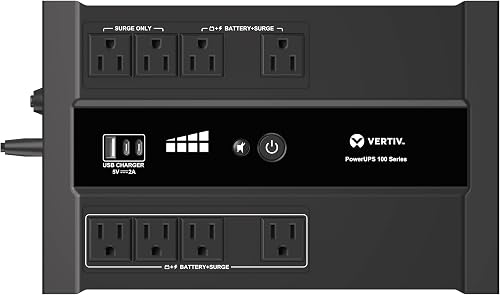
The Vertiv Liebert PowerUPS 100 PST6-1100LVMT suits a camera setup that needs a compact UPS with a replaceable battery. It provides 1100VA and 670W output in a compact enclosure.
Six of its 8 outlets provide battery backup and surge protection. The remaining 2 are surge-only, so reserve the first group for cameras, network equipment and other devices that must remain powered.
The VRLA battery is user-replaceable, and the unit includes USB-A and USB-C ports for charging portable devices. A dedicated alarm mute button can quiet alerts after you address the power issue.
The metal enclosure measures 8.27 x 4.72 x 5.51 in and weighs 9.7 lb. Vertiv identifies standby power, 120V output, 500 joules of surge protection and a 3-year full-unit and battery warranty.
Choose it when serviceability and a smaller enclosure matter. Its lead-acid battery and 670W output make it a middle option between a mini UPS and a high-capacity tower.
How do you choose a battery backup for security cameras?
Choose a battery backup by matching the camera's power type first, then adding the power needs of the router, modem, recorder and other devices. A DC mini UPS can work for a compatible camera, while an AC UPS is more flexible for plug-in adapters and complete systems.
For a camera with a DC input, confirm all of these before connecting a mini UPS:
- Output voltage must match the camera's required voltage.
- Current capacity must meet the camera's requirement.
- The connector size must fit.
- Polarity must match.
- Total output must stay within the backup's limit.
The Shanqiu provides 5V, 9V and 12V DC outputs at 2A, with a 60W maximum output. That makes it useful only when the camera and connector match those requirements.
For a plug-in camera adapter, an AC UPS is usually easier to plan. Connect the adapter to a battery-backed outlet, then connect the router or modem too if remote access depends on the network.
Our guide to the best power supply for outdoor security cameras covers weather exposure and adapter planning.
How much battery backup do security cameras need?
Security cameras need enough UPS capacity for the combined load and enough runtime for the interruption you expect. A 255W UPS can suit a low-power setup, while a 900W or 1000W model leaves more room for recorders, monitors and network equipment.
Start by listing every device that must keep working during an outage. The camera is only part of the total, because the router, modem, recorder and monitor may draw power too.
Add the wattage for each device on battery-backed outlets. That total gives you a clearer target than guessing from the camera alone.
Do not compare VA alone. Check the watt rating as well, then add the wattage of every device connected to battery-backed outlets.
VA and watts describe the backup in different ways, but watts usually line up more directly with the devices you are powering. A high VA number does not help if the watt limit is reached first.
Keep some capacity available above the total so the UPS is not operating at its limit. Running close to the maximum can leave little room for startup draw or a device that uses more power than expected.
The APC BE425M is rated at 255W. The CyberPower CP1500PFCLCD reaches 1000W, the APC BX1500M reaches 900W and the GOLDENMATE reaches 800W.
Those figures help sort the choices by scale. The 255W model fits a small network setup, while the higher ratings suit systems with recorders and several connected devices.
Runtime still changes with the load. A small camera may run longer than a camera plus router, recorder and monitor on the same battery, so connect only essential equipment when outage time matters.
Surge-only outlets can still protect a device without spending battery runtime. Use them for equipment that does not need to stay on during an outage.
Check the ratings on adapters and equipment labels where you can. If a value is unclear, choosing a larger UPS with headroom is often safer than forcing a small unit to carry the whole system.
Should you use a battery-powered security camera instead?
A battery-powered camera can avoid a fixed AC adapter, but it does not remove every power concern. You still need to recharge the camera, and network equipment may continue to need separate power during an outage.
That recharge step is easy to forget in a busy home. A camera that is fine today can become a gap in coverage if its own battery runs low and no one notices in time.
Battery cameras can still suit some homes very well. They may help when an outlet is far away, when cable runs are difficult, or when you want a simpler installation near a door or fence.
The trade-off is that power planning moves to the camera itself. You need to track charging, check battery levels and make sure the camera is ready before a storm or outage.
Network gear adds another layer to the decision. A battery camera may keep recording locally, but remote viewing still depends on a router and modem that have power.
Read What Is a Battery Powered Security Camera? before choosing between a rechargeable camera and a backup supply. It can help you weigh placement, charging and coverage before you commit to one design.
A plug-in camera connected to a UPS can provide a predictable power path when the camera, router and recorder are all compatible. The UPS keeps the chain powered when utility power drops.
That setup can be easier to manage for a fixed system. You mainly need to size the UPS for the load and place it where air can circulate.
For the difference between fixed power and battery operation, see What Is a Plug in Security Camera, and What It Does?. The comparison is useful when you are deciding how each camera will be powered day to day.
The best choice depends on camera placement, access to an outlet and how long you need recording to continue. A battery camera may fit a hard-to-wire spot, while a plug-in camera on a UPS may fit a main entry point.
Think about maintenance as well as initial setup. Recharging a camera, replacing a UPS battery and checking a recorder are different kinds of upkeep.
If you need continuous coverage at a key entrance, a UPS-backed plug-in camera may offer more certainty. If you need coverage in a remote spot, a rechargeable camera may be the more workable option.
How should you set up and care for a security camera UPS?
Place the UPS where air can circulate, keep its power cord and camera adapters secure, and connect only the equipment that needs battery runtime. Check the outlets before installation because some provide battery backup while others provide surge protection only.
Keep the UPS away from high heat, moisture and enclosed spaces. The GOLDENMATE safety notice specifically warns against high-temperature, enclosed or humid environments.
Use the correct cable and verify the camera's voltage before connecting a DC mini UPS. For an outdoor camera, keep the UPS indoors unless its enclosure and installation instructions support the location.
Battery care also depends on the design. Lead-acid models such as the APC and Vertiv choices need attention to battery replacement over time, while the GOLDENMATE uses a LiFePO4 battery rated for more than 10 years and over 5000 charge cycles.
If the camera uses a dome housing, the backup does not solve visibility or enclosure problems. See our guide to the best security camera dome cover when the cover itself needs replacement.
What is the best battery backup security camera setup?
The best battery backup security camera setup uses a UPS that powers the camera and the network equipment it needs. For multiple cameras or an NVR, choose a higher-capacity AC UPS.
For one compatible DC camera, choose a mini UPS only after checking voltage, current, connector and polarity.
Choose the CyberPower CP1500PFCLCD for the strongest overall capacity and sinewave output. Choose the APC BE425M for a compact low-power setup, the APC BX1500M for cameras plus a recorder, or the Shanqiu for one compatible DC-powered camera.
A solar camera can follow a different power plan, especially when its panel and battery are sized for the location. Compare the power design in our guide to the best dual lens solar security camera if you are considering a camera that generates its own charging power.
For most fixed camera systems, connect the camera, router, modem and recorder only when the UPS has enough watt capacity for the combined load. That keeps the backup focused on the devices that protect recording and remote access.
Our top 3 picks at a glance
-
1
Best for larger camera networks
CyberPower CP1500PFCLCD PFC Sinewave UPS Battery Backup
9.7/10 our score
See it on Amazon -
2
Best for a compact router-camera setup
APC BE425M UPS Battery Backup and Surge
9.6/10 our score
See it on Amazon -
3
Best for cameras plus a recorder
APC BX1500M UPS Battery Backup & Surge
9.5/10 our score
See it on Amazon
Frequently asked questions
What is the best battery backup for security cameras?
The CyberPower CP1500PFCLCD is the strongest overall choice for a larger security camera setup because it provides 1500VA/1000W capacity, sinewave output, AVR and 6 battery-backed outlets. For one compatible low-power camera, the Shanqiu mini UPS is smaller and provides 5V, 9V and 12V DC outputs.
Match the backup to the camera's input voltage, connector and total power draw.
Can a UPS power security cameras during an outage?
Yes, a UPS can keep compatible security cameras, routers, modems and recorders powered during an interruption. Runtime depends on the connected load and the UPS capacity.
A camera may remain powered while remote viewing still fails if the internet modem or router is not connected to battery-backed outlets.
Connect the network equipment that the camera needs.
What size UPS do security cameras need?
A small camera and router may fit within a 255W UPS such as the APC BE425M, while a multi-camera system with a recorder needs more capacity. Add the wattage of the cameras, network equipment and recorder, then choose a UPS with room above that total.
The camera's adapter or power supply shows the input requirements you need to match.
Is a mini UPS better than a regular UPS for a security camera?
A mini UPS is better when the camera uses a compatible 5V, 9V or 12V DC input and the total load stays within 60W. A regular AC UPS is more flexible for cameras using plug-in adapters, network equipment or recorders.
Check the connector, polarity, voltage and current before connecting a mini UPS.